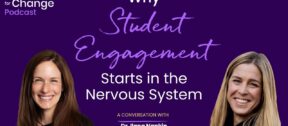

Thirty-nine percent of educators told a national survey they’d never received explicit instruction in classroom management before stepping into their own classrooms, and another 8% had never taken a formal teacher-training program at all (EdWeek Research Center, 2024). Two of California’s most decorated teachers — a state Teacher of the Year and a newly elected teachers-union president — will tell you they belong to that first group, and neither can remember a single lecture, workshop, or serious conversation on the subject from the years they spent training to teach. The question underneath is quieter, and it’s the one that follows a lot of educators home: what am I supposed to have learned, and where was I supposed to have learned it?
We keep calling this a behavior crisis. We talk about phones, screens, post-pandemic grief, student dysregulation, and families under strain, and then we reach for consequence ladders and compliance frameworks built for the classroom of a different decade. What almost nobody says out loud is the sentence that would actually shift the ground under all of it: teachers were never taught this. The gap isn’t in the students; it’s in the training.
The reflex we grew up with, and why it made sense
The reflex most of us walked into teaching with was strict, and you’ve heard the shorthand a thousand times — don’t smile until December, meet them at the door, structure before softness. It’s easy to dismiss now, and dismissing it too fast is a mistake, because the mentors who handed us that rule were solving a real problem in a system that gave them very little else to work with.
First-year classrooms fell apart inside a week. New hires left the field because they couldn’t keep a room together, and strictness gave those educators a rung to grip when their training programs handed them none. It bought time, and it kept people in the profession who otherwise would have walked out. But the rung was low, and the ladder was short.
How classroom management has actually evolved
The field has moved through four stages, each rung a response to the previous rung’s limits:
- Rules — structures imposed by the teacher; the default for a generation.
- Consequences — behavior linked to outcomes, rewarding compliance and penalizing disruption.
- Restorative practices — repair over punishment; prioritizing relationship and accountability at the same time.
- Co-regulation — one settled adult nervous system inviting a dysregulated one back into range; the furthest upstream any approach has reached.
Restorative circles only work in a room that already feels safe enough to enter, and repair only works with a person who feels seen. That kind of seeing is relational work, and relationship was the thing teacher prep programs quietly skipped for decades.
Breathe for Change calls the underlying capacity relational intelligence: the interpersonal awareness, empathy, repair, and belonging that make everything else possible. It’s one of the five layers of the Human Intelligence framework, and the research keeps landing in the same place — in a room where students feel known, the behavior we’ve been managing shows up in a different intensity, and often doesn’t show up at all.
The gap isn’t in the students. The gap is in the training.
What the research says about classroom management training
There’s a growing evidence base underneath the intuition. Pre-service teachers who receive explicit classroom-management training before student teaching show significantly higher self-efficacy and lower intent-to-leave than peers who don’t (Golubtchik, Journal of Education and Learning, 2025). The research base draws heavily on pre-service cohorts and self-reported measures, and longitudinal outcome data is still emerging, but the direction is consistent and it tracks what educators in Breathe for Change trainings have been reporting for a decade.
Breathe for Change’s own outcomes point in the same direction. In the 2023-24 school year, students of Breathe for Change-trained educators showed a 92% attendance rate and an 8% year-over-year reduction in absenteeism (Breathe for Change 2023-24 Impact Data), and those same educators use human-centered strategies at two to four times the rate of comparison teachers — including breathing techniques (91% versus 22%) and emotional awareness practices (68% versus 30%).
Consider what that mechanism looks like across the grade band.
In kindergarten, Kristy Herrera runs a morning circle that goes past how are you feeling into who are you, who’s in your life, who takes care of you. She learns siblings’ names, she takes a first-day photograph with each child and their family and hangs it on the wall for the year, and behavior in her room isn’t the point of the practice — behavior in her room is what shifts as a result of it.
“I really don’t have any memory if there was a conversation or a lecture on it,” Kristy said of her own teacher prep. “Over the years I’ve just come to realize we’ve got it backwards.”
In high school, Chrizia Dela Rosa teaches math to 160 students a day. She swapped the strict-first script for a daily Google-form check-in and student-authored classroom agreements — her students write the norms, she reads every entry, and when conflict shows up she points to the wall and says the words her students recognize as their own. The daily system she built to make this scale is documented separately in the how-to companion to this piece.
At the district level, the same logic scales. A Denver superintendent recently hit record graduation rates by building coherence around exactly this frame — belonging first, behavior second, the classroom argument scaled to a district of tens of thousands.
For the leader deciding where to put the professional-development budget, the numbers work too. A meta-analysis of 213 school-based social-emotional learning (SEL) programs found students in those programs gained an average of 11 percentile points in academic achievement compared to peers (Durlak et al., Child Development, 2011), and the alternative — another cycle of compliance training — hasn’t produced results in a generation.
You hear a version of this from teachers every August: “They gave me the reading pedagogy, the math pedagogy, three semesters of learning theory, and then I stepped into a room of twenty-eight small humans and there was nothing.”
Classroom management strategies that actually work
None of this asks anyone to abandon structure. Kristy has non-negotiables, Chrizia keeps a consequence ladder, and what changes isn’t whether structure exists — it’s the sequence, and the question underneath it.
- Swap the deficit question for a relational one. Instead of what’s wrong with you, ask what do you need right now, and what support is missing. Both Kristy and Chrizia use the question daily, and it names the whole shift in one line.
- Let students write the agreements. They can name what respect looks like and what teamwork looks like, and when you point to the wall two months later, you’re pointing to their words rather than yours.
- Start with the family, not the roster. Kristy asks families to describe their child in whatever language they’re comfortable in, and Chrizia asks students who to call when they’ve done something well — the relationship starts before the first bell.
- Teach predictability as safety. Consistent structures free students to be flexible inside them, and predictability, along with offering choice and voice, are two of Breathe for Change’s seven trauma-informed teaching principles that double as the load-bearing walls of classroom management.
- Regulate yourself first. “If I don’t come in settled and grounded, my kids feel that immediately,” Kristy said, and the co-regulation science behind this is unambiguous — student nervous systems track the teacher’s.
Once the frame is in place, the tactics start to land. From there, Breathe for Change’s practical classroom management strategies collect the specific moves that only work once the frame beneath them is right.
Where educators go to actually learn this
Breathe for Change was founded because our founder, Dr. Ilana Nankin, spent her doctoral research documenting what her own first year of teaching had already shown her — that educator well-being and student learning outcomes move together. She built the organization to close the gap teacher prep left, and that work now sits inside the William Jewell College Master’s of Science in Education (M.S.Ed.) in Transformative Teaching & Learning, in partnership with Breathe for Change. The M.S.Ed. is where educators learn what teacher prep skipped: relational intelligence, co-regulation, trauma-informed practice, and the mindfulness and SEL grounding that make classroom management something you build rather than something you enforce.
For educators ready to go deeper into the frame this piece opens, the M.S.Ed. is enrolling now.
Thirty-nine percent of us stepped into our first classroom without any of this. Kristy did, Chrizia did, and now — years in — they’re the ones being elected to lead. When educators finally get the training the profession was supposed to give them from the start, this is what tends to happen.
Want to go deeper? Listen to the full conversation between Dr. Ilana Nankin, Chrizia Dela Rosa, and Kristy Herrera on A Work of Heart, the Breathe for Change podcast. They cover the classroom management reframe, the shift from compliance to co-regulation, and the specific practices Chrizia and Kristy build their classrooms around.