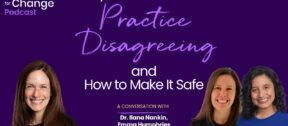

With an election a few weeks away, political topics will come up in class whether they’re on the lesson plan or not. Clear classroom discussion norms give you and your students something solid to stand on when they do. They’re also a chance to show students how people stay connected while they disagree. These six moves come from Dr. Ilana Nankin of Breathe for Change and from Dr. Emma Humphries and Mya Baker of iCivics, and each one fits into this week.
If You’ve Only Got Half an Hour
Three of the six moves take less than half an hour combined, so they’re a good place to begin:
- Tomorrow (about 20 minutes): co-create three behavior-level agreements with your class and post them where everyone can see them (Move 1).
- Before any charged topic (about 2 minutes): three shared breaths and a one-word intention (Move 3).
- The night before a sensitive lesson (about 5 minutes): a short text to families (Move 6).
The payoff is real. Hess and McAvoy studied 35 teachers in 21 high schools. Students who had well-run discussion of controversial issues were more likely to say they’d vote, follow the news, and listen to people they disagree with than peers in lecture-heavy classes (Hess & McAvoy, The Political Classroom, 2015). The comparisons are observational, but every one of them points the same direction.
Build Classroom Discussion Norms Students Own (Moves 1 and 2)
1. Put behavior-level agreements on the wall.
Vague rules give way under pressure, and visible behaviors hold up better. Mya Baker, Chief Learning Services Officer at iCivics and a former 5th-grade teacher and DC principal, starts with “be respectful” and asks, “What does it look like to be respectful when someone says something you disagree with?” One answer a class might land on: “I ask a question before I argue back.”
The ideal time is first-week community building. If August came and went without it, Baker’s advice still holds: “You could do it tomorrow.” After any harmful moment, go back to the list and add whatever was missing.
Dr. Ilana Nankin, co-founder and co-CEO of Breathe for Change, says co-creating community agreements is the first thing Breathe for Change teaches. To hold up under pressure, she says, they “have to have them visible in the classroom.”
2. Ask, “Can you try that again?”
Dr. Emma Humphries, Chief Education Officer at iCivics and a former government teacher in North Florida, uses a simple line: “can you try that again?” If the student needs more, she adds, “this time consider that that could be really hurtful for some of your classmates,” and lets them pass if they’d like. Baker’s version points to the wall: “Can you look at our norms and let me know…”
Use it when a student lands badly but isn’t trying to hurt anyone. They get a second try, and they keep their dignity in front of their peers.
Opening the Conversation and Keeping It Steady (Moves 3 and 4)
3. Take three breaths and set a one-word intention.
Dr. Ilana leads the class through three collective breaths. Then each student finishes “My intention is to be…” with one word, like curious, present, or a good listener. Go around the room so every voice is heard.
It works at the start of a planned discussion. It also works when a topic shows up unplanned from lunch or recess. Dr. Ilana has used it with pre-K students.
The research is encouraging. A meta-analysis of 24 school-based mindfulness studies found small to moderate benefits for stress and resilience (Zenner et al., Frontiers in Psychology, 2014). Those were multi-week programs, though. Three breaths draws on that evidence, but that evidence doesn’t prove it works on its own.
4. Decide: pause, stop, or hallway.
This is a three-way call. Pause if the student isn’t trying to hurt anyone, and go to Move 2. Stop with confidence if a comment dehumanizes someone or names a classmate. Save the follow-up for the hallway. Humphries never gets into it with a student in front of peers, because backing down feels impossible there. Lean on your conflict resolution skills for that conversation.
You’ll make this call in the moment, and you can also make it while planning. If one class period isn’t ready, switch that group to individual written reflection. As Humphries puts it, “first things first you’ve got to protect the kid.”
Handle the Questions That Reach Home (Moves 5 and 6)
5. Answer “Who are you voting for?” without answering.
Humphries recommends keeping your vote private. You can deflect with a joke (she suggests something like “I was thinking of voting for Eisenhower”), or you can say, “What matters is that you know which candidate you support and why.” Baker tells students about the first time she went to the ballot box and how nervous she was. Either way, the question goes back to the students and their own participation.
6. Text families before a sensitive lesson.
Send a short heads-up the evening before. It matters most around first parent conferences. Here’s Humphries’s example: “Hey, tomorrow we’re talking about federalism, which I know seems really benign, but when you get down to some of the court cases and recent examples, it gets a little political. I just want you to know that my goal is to make sure your student understands how our democratic republic works and what their role is in it.”
This way, families hear your goal from you before they hear about the lesson secondhand. “Parents are not the problem,” Humphries said. “Parents are assets.”
Classroom Discussion Norms: What Teachers Ask Most
What are good discussion norms for controversial topics? Good norms name a behavior, not only a value. So “be respectful” becomes “I ask a question before I argue back.” Co-create three with your class, post them, and add to them after any harmful moment.
Should teachers tell students who they’re voting for? Dr. Emma Humphries recommends keeping your vote private and turning the question back to students. What matters is that they know which candidate they support and why.
What should I do when a student says something hurtful in a discussion? If the student isn’t trying to hurt anyone, pause and ask them to try again. If the comment dehumanizes someone or names a classmate, stop the discussion and follow up privately in the hallway.
Bringing It Together
None of these moves require a new curriculum. All six draw on two capacities from the Human Intelligence framework that Breathe for Change teaches. Relational intelligence helps you hold connection, and repair it, when people disagree. Somatic intelligence helps you notice and settle your own nervous system before you respond. To go further with the first one, explore relational intelligence for teachers. For the bigger case behind these moves, read how to make disagreement safe in your classroom.
Co-creating community agreements and setting intentions are both practices taught in the William Jewell College Master’s of Science in Education (M.S.Ed.) in Transformative Teaching & Learning, in partnership with Breathe for Change. William Jewell College awards the degree. Explore the M.S.Ed.
Want to go deeper? Listen to the full conversation between Dr. Ilana Nankin, Dr. Emma Humphries, and Mya Baker on A Work of Heart, the Breathe for Change podcast. They talk through all six moves, plus why students self-censor and what school leaders can do to help.