
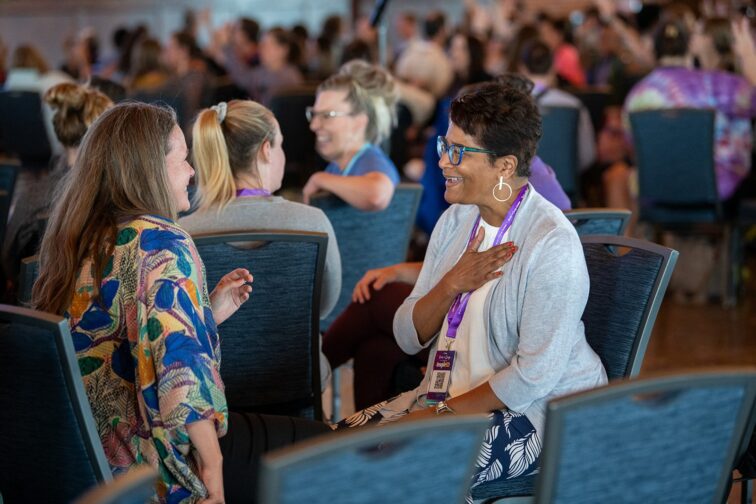
For most of the school day, teachers are the only adult in the room. Teacher collaboration, when it’s on the calendar at all, tends to mean a data meeting, not a colleague who knows how your week is actually going. Below are three relational practices to try with one trusted colleague: mindful listening, desires, fears, and requests, and repair that names your impact.
Teacher Collaboration Begins With One Check-In
You don’t need a new team or a title. Michael Fenchel, co-founder and co-CEO of Breathe for Change, suggests “finding a peer, a colleague that you can sync up with even just once a week.” To get started:
- Ask one colleague (5 minutes). Pick someone you trust. They don’t have to be on your grade-level team. Ask if they’d like a standing check-in.
- Book 20 minutes a week. Keep the same day and time, and open with one question: how’s it actually going?
- Split work by strengths (10 minutes, once). Name what each of you does well and trade accordingly. Maybe one of you drafts the parent letter while the other builds the rubric.
What you do with that time matters, too. In Miami-Dade schools, teachers in higher-quality instructional teams posted larger gains in math and reading and improved faster over time (Ronfeldt et al., 2015). That study measured instructional collaboration, not the relational practices below. Still, it’s a good reason to protect the time. Once the two of you find a rhythm, you can grow it into a small peer group.
1. Mindful Listening Before You Decide
One of you talks. The other listens without drafting a reply, judging, or drifting to a to-do list. When the speaker finishes, the listener reflects back the heart of what they heard. Dr. Ilana Nankin, co-founder and co-CEO of Breathe for Change, calls it giving someone “the gift of my literal presence.”
When to reach for it. Open every weekly check-in with it. It also helps any time your colleague brings you a problem and you feel the pull to solve it on the spot.
What the research says. In a series of experiments, high-quality listening lowered speakers’ defensiveness and led them to more nuanced views (Itzchakov, Kluger & Castro, 2017). Most of that evidence comes from lab settings, though, rather than schools.
Try saying: “What I’m hearing is that the schedule change isn’t the real issue, and that it stung because nobody asked you first. Is that right?”
It’s the grown-up cousin of the mindful listening protocol you may already use with students.
2. Desires, Fears, and Requests When You Disagree
It’s a three-part structure for conflict. Say what you want, name what you’re afraid of, and make one concrete request. Michael taught it to Dr. Ilana early in their partnership. She returned the favor with nonviolent communication, a sibling practice built on naming feelings and needs.
When to reach for it. In the middle of a disagreement, as soon as you catch yourself defending a position instead of explaining what’s at stake for you.
Why it helps. Once you’ve named a fear, a vague grievance becomes something your colleague can actually respond to. As Michael put it, an uncomfortable feeling is “information that we need.”
Example template (written for this guide, not a quote):
- Desire: “I want our unit to end with a project students are proud of.”
- Fear: “I’m afraid that if we cut the presentation day, the quieter kids won’t get seen.”
- Request: “Could we keep one presentation day and trim the review packet instead?”
3. Repair That Names Your Impact
When something lands badly, start by owning how it affected the other person. Explain what you meant after that. Then name the pattern you both may have slipped into. Michael describes his own version: “I’ve acknowledged and taken responsibility for the fact that… how I showed up led to you being afraid.”
When to reach for it. Within a day of a rupture, and in small moments too. Dr. Ilana describes “micro moments of repairing” that the two of them still do every day.
What the research says. In experiments on apologies, acknowledging responsibility was rated the most effective of six components (Lewicki, Polin & Lount, 2016). Those studies used hypothetical scenarios with non-educators. For Dr. Ilana, though, hearing Michael own his impact meant she could “rest easy and exhale.”
Try saying: “When I cut you off in the team meeting, it made it look like your idea didn’t matter, and I’m sorry. I think I rush when I’m anxious about time, and you go quiet when I rush.”
If you’ve taught students repair skills, this is the adult-to-adult version.
Before Your First Parent Conferences
October’s parent conferences make a good first test for your pairing. Before a hard meeting, run desires, fears, and requests with your colleague so you know what you want the family to walk away with. Then, in the room, reflect back what the parent said before you respond.
Quick Answers on Teacher Collaboration
What is teacher collaboration? Teacher collaboration is any regular, shared work between educators: planning units, analyzing student work, or supporting each other through hard weeks. Most school structures focus on the first two. This guide is about the relationship underneath, the one that makes the shared work possible.
How often should teachers collaborate? Start with a standing 20-minute check-in once a week with one colleague. A short check-in that actually happens every week beats a long monthly meeting that keeps getting cancelled.
What if my colleague and I disagree? Use desires, fears, and requests: say what you want, name what you’re afraid of, and make one concrete request. If the conversation goes sideways, repair within a day by naming your impact first.
Do I need my principal’s approval to start? No. All a peer check-in needs is two willing colleagues. If it works, a small peer group or a school-wide structure can grow from there.
Start With One Colleague
You don’t need a schedule overhaul for any of this, just one colleague and twenty minutes a week. For the bigger argument behind these practices, read why you don’t have to lead alone.
All three practices build relational intelligence, one of the five layers of the Human Intelligence framework. They’re also core practices in the William Jewell College Master’s of Science in Education (M.S.Ed.) in Transformative Teaching & Learning, in partnership with Breathe for Change. Dr. Ilana notes that desires, fears, and requests and nonviolent communication are both woven into what the program teaches. William Jewell College, accredited by the Higher Learning Commission, awards the degree. Learn more about the M.S.Ed.
Want to go deeper? Listen to the full conversation between Dr. Ilana Nankin and Michael Fenchel on A Work of Heart, the Breathe for Change podcast. They talk through how they learned to listen, disagree, and repair across 11 years of leading together.