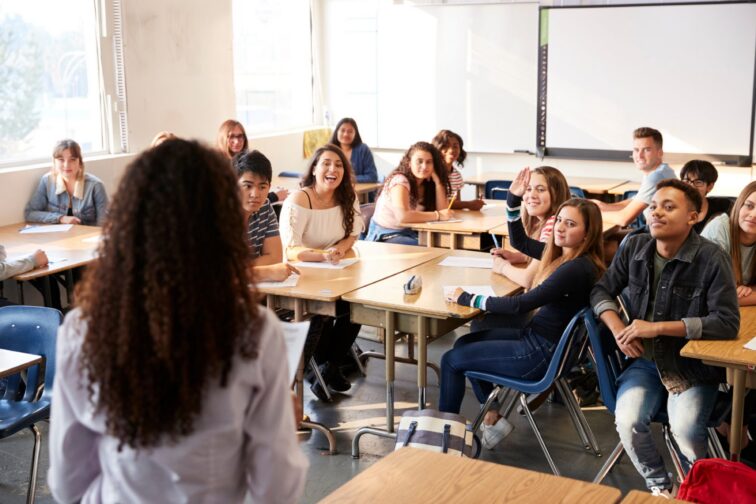
Election season tends to walk into classrooms whether it’s on the lesson plan or not. As Dr. Ilana Nankin, co-founder and co-CEO of Breathe for Change, describes it, a student repeats something they heard at the dinner table, another student’s face drops, and twenty-five or thirty kids turn to the adult in the room to see what happens next. Most educators were never trained for that moment, and many have decided the safest move is to avoid the conversation altogether.
Students notice. In a September 2026 survey of recent high school graduates from the Sandra Day O’Connor Institute, 53 percent said they had sometimes or often seen a teacher avoid, cut short, or shut down a political or current-events discussion. Fifty-eight percent said they had held back an opinion of their own in class (Sandra Day O’Connor Institute, 2026).
On a recent episode of A Work of Heart, Dr. Ilana talked with Dr. Emma Humphries and Mya Baker of iCivics about what to do instead. She was clear about the goal from the start: the conversation is “absolutely not about who’s right. It’s about building a classroom and a school culture where every single student feels seen, where they feel heard, where they feel like their perspective is valued and honored, including, and I would say most importantly, when they disagree.”
Avoiding the Conversation Doesn’t End It
When a hard topic gets tabled in class, students still talk about it. They just do it somewhere else. Mya Baker, a former teacher and principal who now leads learning services at iCivics, once asked a superintendent which social studies curriculum the district relied on. “Students aren’t thinking about this curriculum or that curriculum,” the superintendent told her. “They’re having these discussions on TikTok and on Instagram.”
Those feeds tend to show students more of what they already believe. Dr. Emma Humphries, iCivics’ Chief Education Officer and a former high school government teacher, points out what happens when two students raised in different feeds finally meet: each assumes the other saw the same information and reached a terrible conclusion. Without practice in class, students have few places to learn that a classmate can see something differently and still belong in the room.
Students Are Mostly Watching Each Other
The O’Connor Institute survey found something that changes how we think about safety. Among the students who held back their opinions, 91 percent said they were worried about their classmates. Forty-one percent named the teacher.
So the risk students feel lives mostly between them. A teacher steering around the topic doesn’t change that. What changes it is a room where students know how to disagree with each other and still feel like they belong, and that’s something educators can build on purpose.
It Starts With the Adult
Before any practice reaches students, it has to reach the educator leading it. “When you have 25 to 30 sets of eyes staring back at you as a teacher, that’s a lot of pressure,” Baker said. If a teacher walks into a hard conversation anxious, “kids are going to pick up on that really quickly.”
This is the center of how Breathe for Change approaches the work. “It starts with us embodying what we teach,” Dr. Ilana said. “We cannot teach our students how to engage in courageous discourse if we are not willing to be vulnerable and courageous ourselves.” She describes the change in three steps: transformation of self, then transformation of teaching, then transformation of learning outcomes.
Two layers of the Human Intelligence (HI) framework do most of the work here. The somatic layer is the body-level awareness that lets an educator notice rising tension and settle it, for themselves and, through co-regulation, for the room. The relational layer is the ability to read a room and build the kind of belonging that lets a student say something honest. Research points the same way: Jennings and Greenberg’s prosocial classroom model holds that teachers’ own social and emotional competence shapes classroom relationships and climate (Jennings & Greenberg, 2009).
Practices That Make Disagreement Safe
None of these require a new curriculum. They work in any subject and at any age.
Arrive together first. Before a hard conversation, Dr. Ilana starts with three collective breaths. Then she names what’s true: everyone is coming in with different perspectives and different information. “Can we engage in this conversation in a way that has everyone here still feeling safe? What do y’all think?”
Set an intention. Ask students how they want to be in the conversation, not what they want to do, and have each one land on a single word: curious, open, kind, a good listener. “I can guarantee you would have two completely different conversations,” Dr. Ilana said. She did this with her pre-K students.
Make agreements specific and visible. “Be respectful” is a good start, but Baker pushes classes to define it: “What does it look like to be respectful when someone says something you disagree with?” Dr. Ilana adds that agreements have to stay on the wall, and they can change. If something hurtful happens that no agreement covered, the class can write a new one.
Ask questions instead of giving verdicts. Humphries doesn’t tell students whether a president’s action was constitutional. She asks whether a president should have that power, which keeps the focus on ideas instead of personalities.
Give students a way back. When a comment lands hard and the student wasn’t trying to hurt anyone, Humphries pauses and asks, “Can you try that again?” If a comment targets a classmate, she stops it and follows up privately, because a student corrected in front of peers “can’t lose,” so “they’re going to go down fighting.”
For step-by-step versions of these practices, see discussion norms for hard conversations.
Every Educator Is a Civics Teacher
These moments don’t only come up in government class. Dr. Ilana’s favorite part of election season as a pre-K teacher was holding a class election, where students debated and voted on real questions. (Nap time, she admits, should never have been on the ballot.) Baker has watched students carry discussion habits from one classroom into another: “Actually, Miss Baker… we did this in my other classroom.”
By the end of the conversation, the guests put it simply: “We are all civics teachers.” Any educator who holds a room where students can be wrong, try again, and disagree without ridicule is teaching the same skill.
Leaders Go First, Too
Teachers need to know someone has their back before they open these conversations. Baker says leaders owe teachers three things first: support for their own regulation, real facilitation skills, and good materials. Humphries adds a fourth: “Tell your teachers you have their back.”
Baker’s advice to principals mirrors what Dr. Ilana asks of teachers: “Model for your teachers what you want them to do for their students.” If a staff meeting ends with “Any questions?” and the room stays silent, that’s the place to start.
The Room Students Need
Building that kind of room is learnable, and it starts with the educator. It sits at the heart of the William Jewell College Master’s of Science in Education (M.S.Ed.) in Transformative Teaching & Learning, in partnership with Breathe for Change. Dr. Ilana describes the degree as an answer to one question: “How do I become the educator where the hardest conversations become the best learning experiences?” Learn more about the M.S.Ed.
The election will come and go. Learning to disagree with a classmate and stay in the room is a skill students keep.
Want to go deeper? Listen to the full conversation between Dr. Ilana Nankin, Dr. Emma Humphries, and Mya Baker on A Work of Heart, the Breathe for Change podcast. They cover why students hold back, what makes disagreement safe, and how to answer when a student asks who you’re voting for.