
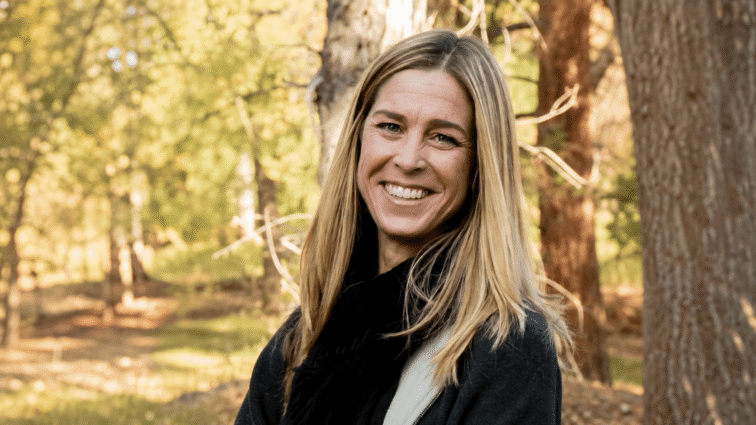
The organizers warned her. As the closing keynote at Montana’s statewide administrator conference, Beth Schreiber should expect people to drift out, reopen their laptops, and mentally clock back into work. Instead, she opened by asking the room to do one thing: stay fully present for an hour. Then she led a few hundred superintendents, principals, and directors through three slow collective breaths. Nobody left. The laptops stayed closed. By the end, there were tears. A second-grade teacher had just quieted a roomful of the state’s busiest leaders with her breath.
Schreiber has spent more than twenty years in education, most of it in Montana classrooms ranging from kindergarten to middle school, most recently second grade. She is now the director of curriculum for her district, responsible for what gets taught in every classroom. She is also a graduate of the first cohort of the William Jewell College Master’s of Science in Education (M.S.Ed.) in Transformative Teaching & Learning, in partnership with Breathe for Change, and she now serves as faculty in the program. None of that was the plan. For most of her career, Schreiber was quietly running on empty, and she very nearly left teaching for good.
The Year She Almost Walked Away
By 2022, two decades in, Schreiber was depleted. In the wake of the pandemic she had a class carrying severe trauma histories, and she had nothing left to give. “I was so empty. I couldn’t reach them. I just didn’t have what it took to give anymore. I had overgiven,” she says. Then an email from Breathe for Change that she had been ignoring finally pulled at her, and she signed up.
What changed first was not her teaching. It was her. On that first call with educators from across the country, the isolation broke. “For the first time I looked back through my career and I felt validated and seen,” she says. And her classroom, she noticed, began to settle before she had taught her students a single technique. She was responding instead of reacting, and the room responded to her.
Then she ran the experiment. For her master’s practicum, Schreiber gathered colleagues for a twice-weekly after-school session of yoga and short practices and surveyed them on stress and job satisfaction. She expected stress to drop. What she did not expect was the second graph. In six weeks, stress fell sharply and job satisfaction rose by an equal amount. Teachers who had been quietly looking for the exit were now writing that they did, in fact, have what it took to stay.
A Calling She Kept Tripping Into
Teaching was in Schreiber’s blood. Her mother and aunts were teachers, and although she did not set out to follow them, she kept, in her words, tripping into it until it became undeniable. She walked into her first classroom certain she had everything she needed. She knew how to teach reading and math. What no one had prepared her for were the students arriving with what she calls “energetic backpacks of trauma and stress and overwhelm and dysregulation,” and a profession that never put educator well-being “on the menu.” Like so many teachers, she pushed through, got competent at survival, and drifted a little further from the love of it each year.
The turn, when it came, was not about a new technique. It was about giving herself permission to be a full human in front of her students and her peers. “I had to put myself back together first before I could even consider putting a classroom together,” she says. Once she did, her colleagues started asking what was different, her principal started paying attention, and the teacher who had been on her way out the door found herself onstage, then in graduate school, then leading.
From First Cohort to Faculty
Schreiber’s story and Breathe for Change are now woven together. She entered the organization’s training in 2022, graduated last June in the very first cohort of the M.S.Ed., and today serves as faculty in the same program, helping shape it for the educators who come after her. Her master’s research, the six-week study that flipped her colleagues’ stress and satisfaction, is exactly the kind of evidence behind a core Breathe for Change conviction: you cannot transform student outcomes without first caring for the educators doing the teaching. Schreiber is living proof of the sequence. Tend to the teacher, and the classroom follows.
For the Educator Running on Empty
Schreiber’s message to exhausted teachers is direct: you are not doing it wrong. “You’re so needed, and you’re so valuable, and you’re not doing anything wrong,” she says. The missing piece was never your effort. It was that no one taught you to give to yourself the way you give to everyone else. Her invitation is to start small and start with you: one breath, one honest check-in, one question about what your own body and heart actually need today.
Educators curious about the practices that brought Schreiber back to the profession, and the framework she now helps teach, can explore the M.S.Ed. As she puts it, it is not too late, and it can work quickly.