
Written by

Topics
Somewhere in the Bay Area, in the mid-1990s, a six-year-old girl is sitting in the back of a car between her mother and her aunt. Chrizia Dela Rosa is newly arrived from the Philippines, kindergarten starts soon, and she’s crying. She’s crying in Tagalog because she doesn’t yet have the English for the fear she’s trying to name: I don’t know what I’m going to do. I don’t know what I’m going to do. Her family is dropping them off. She has no friends here yet. She doesn’t know how to be here.
Meet Miss Dela Rosa
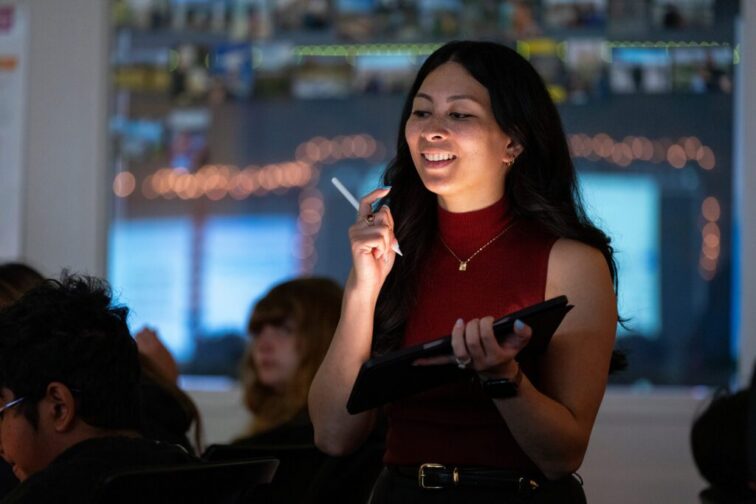
Thirty years later, Chrizia teaches high school math at Piedmont Hills High School in San Jose. She’s been in the classroom for 13-plus years. In 2026, out of California’s roughly 300,000 public school teachers, the state named her its Teacher of the Year.
She’s five feet tall, a former “bench captain” of her high school basketball team, and she’ll tell you basketball was her second language before English was her third. Her students call her Miss Dela Rosa and give her a hard time for insisting on a daily check-in every single period. She insists anyway.
A Classroom Built on Purpose
Chrizia’s classroom is a system. She stands at the door before every period and greets each student by name. She opens class with a Google Form asking students how they’re feeling, scans the results, and if she spots a student having a rough day, she writes them a post-it note before the lesson starts. She teaches the neuroscience of the fight-flight-freeze response in the first week of school, with a stress ball she throws without warning to demonstrate the response in real time. She calls the hippocampus the “hip campus”, a joke her husband gave her, and one her students remember better than any test-prep mnemonic. Halfway through the period, if the energy drops or spikes, she runs a two-minute reset: a number game, a high-five hunt, or a four-count inhale and eight-count exhale. She closes every class with a written reflection.
That’s a lot to run every day. It exists because Chrizia knows what happens to a child when a classroom isn’t built for them. Positive teacher-student relationships show medium-to-large associations with student engagement across the research, and the effects grow stronger in secondary school (Roorda et al., Review of Educational Research, 2011). Chrizia didn’t build her classroom around the studies, though. She built it around Miss Tran.
The Miss Tran Story
Miss Tran was Chrizia’s second-grade teacher, a Vietnamese woman who somehow already knew Chrizia’s name on the first day of school. Chrizia doesn’t know if Miss Tran had asked her first-grade teacher, or looked it up, or practiced. She only knows that on the day she walked in expecting to hide, this teacher said her name correctly. And that in Miss Tran’s classroom, learning didn’t feel like learning. Chrizia stopped being ashamed to bring her mother’s Filipino food to lunch.
When Chrizia’s family moved away later that year, Miss Tran wrote letters through the summer to check in.
Chrizia’s family eventually settled in Fresno, in a predominantly white community, and some of what Miss Tran had opened, Chrizia closed back down. She wanted straight hair. She wanted pizza in her lunchbox. She had teacher after teacher who mispronounced her name, spelled C-H-R-I-Z-I-A and rarely said correctly. But Miss Tran stayed the template. The teacher who already knew.
Chrizia joined Teach For America in 2013 and was placed at a high school in Miami teaching math. She stayed three years, sometimes horizontal on her couch after school, crying, asking whether she could do the work at all. She stayed anyway. Her older sister Christine took the Breathe for Change training in 2016, the first Bay Area cohort, and Chrizia watched Christine start bringing those practices into her own high school classroom. Five years later, Chrizia knocked on Ilana Nankin’s door.
Where Breathe for Change Fits
Chrizia went through the Breathe for Change training expecting to walk away with strategies for her students. She walked away with something else, too. “I’m worthy of this time for myself,” she says of the shift. “I deserve to care for me.” The training didn’t hand her classroom practices as tools bolted onto who she already was. It gave her the room to become the teacher who could actually use them. Breathe for Change has certified more than 20,000 educators to date and worked with 750 district partners. Chrizia is one of them, and a proof point that the model travels.
When One Classroom Becomes a Blueprint
For assistant principals, deans, department heads, and SEL directors, Chrizia’s classroom shows what one teacher does can be built by any teacher given the right training. Look at how belonging-centered leadership drives school-wide outcomes for an adjacent leadership case study. A meta-analysis of 213 SEL programs across 270,034 K-12 students found an 11-percentile-point academic gain over controls, with effects consistent across school levels (Durlak et al., Child Development, 2011). Belonging scales when leaders build the conditions in which teachers can practice it, day after day, without asking permission.
For educators whose own belonging journey mirrors Chrizia’s, why human intelligence begins with the educator knowing themselves is the natural next read. And for the classroom teacher looking at a roster full of students who feel different (multilingual, neurodivergent, quiet, new), creating belonging for students who feel different is where the work lives.
Find Your People
Ask Chrizia for the takeaway and she’ll give it plain, no flourish: “I think it’s really important for people to find their people.”
For Chrizia, the first people were her family. Then Miss Tran. Then her sister Christine. Then Breathe for Change. Then a school full of colleagues in San Jose who told her, when she pitched an idea, yes, and let’s figure out how. Every year, at Piedmont Hills, she’s Miss Tran for a new group of high school students who walk in expecting to hide. Somewhere in her fourth-period classroom, a kid who came in ready to disappear is being greeted by name at the door.
Chrizia credits the Breathe for Change training with giving her the tools, and the space, to become the educator she is. The William Jewell College Master’s of Science in Education (M.S.Ed.) in Transformative Teaching & Learning, in partnership with Breathe for Change, is where educators build those same capacities.
Listen to the full conversation between Dr. Ilana Nankin and Chrizia Dela Rosa on A Work of Heart, the Breathe for Change podcast.