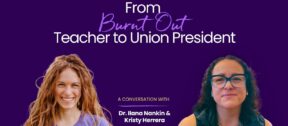

If you’re a veteran teacher who did the salary math on a master’s degree and moved on, Kristy Herrera’s story is worth a second look.
Kristy did the math once already. When she first considered a master’s, her district paid $1,000 a year for the credential. She’d come to teaching in her thirties, after a first career in commercial interior design, and she had a family. By her own count, she was already past the point where a decade of tuition payments would ever pay back. She said no.
Today, she’s finishing that master’s and stepping in as her teachers union’s president. She isn’t retiring in two years anymore. She’s staying at least five. What changed her mind wasn’t a bigger salary bump. It was discovering what the degree was actually for.
The teacher she almost wasn’t
Kristy nearly didn’t become a teacher at all. Her path started, of all places, on jury duty.
She was serving on a four-month murder trial. Her son was in kindergarten, and she learned that her own former kindergarten teacher, then in her seventies, would be covering his class. Kristy asked the judge for a longer lunch, dug out a framed 1973 photograph of the two of them on the playground in matching red-white-and-blue outfits, and drove to her son’s classroom.
The teacher remembered her. Remembered her friends. Remembered her name.
Kristy sat through the rest of the trial knowing what she was going to do next. The day she got back from jury duty, her entire commercial design department was laid off. She calls it the universe looking out for her.
Becoming a teacher was the easy part. Her first five years in the classroom were, in her words, “horrifically hard.” She loved the children and stayed, but she was running on grit, and grit alone doesn’t last 24 years.
Finding the work
In 2018, sixteen years into teaching, Kristy found Breathe for Change on Facebook. She was a group fitness instructor at the time, and the program caught her eye because it paired educator well-being with social-emotional learning. She signed up.
What she learned there she brought straight into her kindergarten room. A basket of colored emoji cards. A two-word check-in built on a sentence stem: “I feel _____ because _____.” A calm-down spot with a timer. Classroom jobs, including a kindness ambassador whose task is to watch for kind acts all day and name them at closing circle.
The morning circle became the center of it. If Kristy’s classroom has one identifying feature, it’s that children feel safe in it, and the morning circle is where that safety gets built. In the language of Breathe for Change’s Human Intelligence framework, it’s a daily practice in relational and somatic intelligence: the capacities that make co-regulation and belonging possible, and that make learning possible at all.
She had a reason to lean on it. The year before she started her master’s, her class was 25 students, 19 of whom entered kindergarten with no English at all. She was an English-only teacher in a monolingual room; the bilingual room was full. She couldn’t see how she was going to teach these children both English and grade-level content in a single year. That question would become the center of her graduate work.
The master’s she almost skipped
When Breathe for Change launched the master’s program, Kristy was 57 and two years from planned retirement. She almost said no again, for exactly the reason she’d said no the first time: the salary math still didn’t obviously pencil out. Her district’s master’s premium had risen to $2,000 a year, still below what many districts pay.
The salary lane is real, but it varies widely by state and district. Here’s what the research shows on average:
| Year-one premium | ~$2,760 above peers without a master’s |
| Career-maximum premium | ~$7,358 more per year at career peak |
| Estimated lifetime premium | ~$200,000 over a 30-year career |
| Avg. top-of-lane salary (master’s + experience) | $94,933 in 2024-25, up 4% year over year |
(Sources: National Council on Teacher Quality, district salary schedule analysis; National Education Association, 2024-2025 Teacher Salary Benchmark Report)
These are national averages, and state and district variation is significant. A master’s may increase individual earning potential over time; it doesn’t guarantee it.
What tipped the decision wasn’t the money. It was the program itself. Kristy had already spent seven years living the underlying Breathe for Change work, and the William Jewell College Master’s of Science in Education (M.S.Ed.) in Transformative Teaching & Learning, offered in partnership with Breathe for Change, would give it a formal container. The M.S.Ed. is HLC-accredited via William Jewell College, FAFSA-eligible, and priced at $14,790 total tuition. She enrolled in the first cohort.
What the data said
Kristy’s faculty advisor was Dr. Ilana Nankin, co-founder and co-CEO of Breathe for Change. Kristy arrived at their first meeting with big plans: new programs, wellness initiatives, yoga classes for parents. Dr. Nankin sent her back to the classroom in front of her. “You’re already doing the work,” she told her. “Document it. Collect the data. Analyze it.”
So Kristy’s capstone question became the one that had been keeping her up at night: How does a daily morning circle impact language acquisition and academic progress for English language learners in kindergarten?
She spent six months studying her own classroom. She kept a notebook in her pocket and wrote down what she heard: a child holding up a card because they didn’t have the words yet, then the same child saying “I feel happy, I like school,” then “I feel excited because my mom gave me ice cream.” She tracked academic benchmarks at the start of the year, in November, in February, and at year’s end.
The numbers surprised her. By November, 80% of her students had hit the beginning-of-year benchmark. By February, 95% had reached it. By year’s end, 99% had improved. Her read: the morning circle made the room safe enough that children could stop protecting themselves and start learning. Language and academics rode on top of that safety, not around it.
The research wasn’t the hard part. Writing an academic paper after twenty-five years away from college was. Dr. Nankin met her where she was and told her about her own dissertation, written in two days, longhand, in her authentic voice at a historical society in Wisconsin. Kristy took the permission and wrote it her way, 70-some pages of it, during a year when her mother nearly died and she was living at her mother’s house to help her recover. She finished as a graduate of the M.S.Ed. and went on to mentor later cohorts.
What the degree actually returned
Here’s the part the salary math never captured.
The year after her capstone, Kristy walked into another hard class, and this time she wasn’t only surviving it. She had data. She had language. She had an evidence base. So she started to advocate: first in emails to her principal and the district, then in three speeches to the school board, including one where she likened a kindergarten classroom to an emergency room she was forced to triage.
People noticed. Her union asked her to run for president. She said no, then a week later said yes, and was elected by Monday. She hasn’t doubted it since.
That’s the return, and it never showed up on the salary schedule. Not $2,000 a year, but five more years in a career she’d been ready to close, and a second act as the person her colleagues chose to speak for them. At 58, she’s stepping into the second-most-influential role of her career.
For teachers who did the same math
If you’re mid-to-late career and have already written off a master’s as not worth it, Kristy’s story is worth sitting with. She ran the same numbers and reached the same no the first time. What changed for her wasn’t the size of the raise. It was the return she started to care about: the shape of the years she still had in the classroom, and what she could do with them.
Ask what a master’s would be worth to you if the answer changed how long you stayed, not how much your district paid you. That’s the question Kristy answered without meaning to.
If her story raises it for you, the online master’s in education explains what the M.S.Ed. covers, and what you can do with a master’s in education walks through the paths graduates have taken. The M.S.Ed. program page has cohort dates, the full tuition breakdown, and the application. The degree is HLC-accredited via William Jewell College and FAFSA-eligible; total tuition is $14,790.
Kristy tells her full arc, including the ER triage speech and the union presidency, in her conversation with Dr. Ilana Nankin on A Work of Heart, the Breathe for Change podcast.