You’re in the middle of a small-group lesson when it starts. Two students at the back table, voices climbing. A pencil gets snatched. A chair scrapes. Within thirty seconds, half the room is watching them instead of the task in front of them, and three more hands shoot up: “Miss, he took my…” “Miss, she said…” You stop teaching. You walk over. You become the referee for the seventh time today.
There’s another way. You can teach your students to resolve their own conflicts using a four-step protocol they can run themselves, even at five years old. It’s called the peace process, and it’s adapted from Dr. Marshall Rosenberg’s nonviolent communication framework (Rosenberg, Nonviolent Communication: A Language of Life, 2015). Here’s how to teach it.
Step 1: Create a Peace Corner for Conflict Resolution
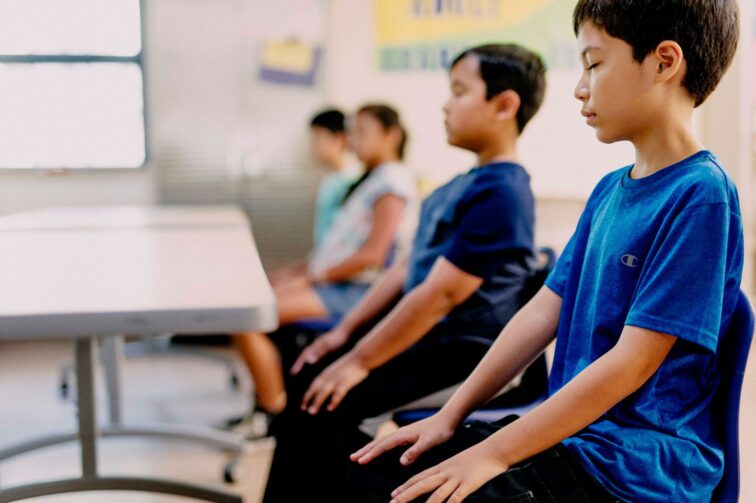
Designate a small, distinct space in your classroom: two chairs facing each other, a soft rug, maybe a basket of calming tools. A basket of nervous system regulation tools (breathing cards, fidgets, a glitter jar) gives students something to do with their hands while they settle. This is where conflict work happens. Not your desk. Not the hallway. A dedicated space cues students that something specific happens here, and that something is repair.
The peace corner should feel safe and ordinary, not punitive. Students should associate it with we work things out here, not I’m in trouble.
Step 2: Teach the Four Steps of Conflict Resolution Explicitly
The peace process has four steps. Teach them in order, with examples, and then model them yourself in front of the class until students have heard the language enough times to use it without prompting.
- Observation. State the facts. What actually happened, with no opinion, no judgment, no generalization. “When you took my pencil…”
- Feeling. State how you felt or feel. “I felt sad…”
- Need. State the underlying need that wasn’t met. “…because I had a need for cooperation.”
- Request. Make a specific, doable request. “Would you be willing to give me my pencil back?”
The needs step is the one most students (and most adults) will struggle with. Help students build a small vocabulary of needs words: connection, fairness, safety, belonging, respect, communication, space. Post them on the wall near the peace corner. For a printable version of the four steps and a needs vocabulary word list, see our peace process classroom resource.
Step 3: Model Conflict Resolution Before Students Try It
You will need to model the peace process for your students many more times than feels reasonable before they start using it on their own. Use real, low-stakes situations from your day with a co-teacher, a teaching assistant, or a student who volunteers:
- “When you were five minutes late to our planning meeting, I felt frustrated because of my need for reliability. Would you be willing to send me a text next time if you’re running late?”
- “When the markers got left on the floor, I felt overwhelmed because of my need for order in our classroom. Would you be willing to help me put them back?”
The goal of modeling is co-regulation: when you demonstrate calm, structured language in conflict, your students’ nervous systems take the cue. After two or three weeks of modeling, invite a student to do it with you. Then invite two students to practice together in front of the class. By the time students see the protocol used four or five times, most are willing to try it themselves.
Step 4: Shift Your Role from Referee to Coach
Here’s the shift that matters: when a student comes to you mid-conflict, you no longer solve the problem. You redirect to the peace corner. “Sounds like you two have something to work out. Go to the peace corner and try the peace process. Come tell me what you decided.”
Some students will need a sentence stem card the first few times. Some will need you to sit nearby while they try. But within a month or two of consistent practice, the pattern flips. Students stop tattling. They start telling you what they figured out themselves: we decided to share, we decided he goes first this time, we decided to take turns with the markers.
Try This Today
Before your next morning meeting, write the four steps on chart paper: Observation, Feeling, Need, Request. Walk students through them with one short example, then ask each student to name one feeling they’re carrying into the day and one need they have for their classroom community. That’s the entry ramp. The full peace process builds from there.
Why Conflict Resolution Skills Matter More Than the Outcome
The success of this practice has nothing to do with how the other person responds. A student can use the peace process perfectly and the other student can still say no. That’s data, not failure. The point of the protocol is to give the speaker a way to name what happened, what they felt, what they needed, and what they’re asking for, in language that doesn’t escalate. That skill compounds for life.
Teaching conflict resolution this way changes the culture of a classroom faster than almost anything else. Students stop seeing conflict as something teachers fix and start seeing it as something they can navigate themselves. That’s relational intelligence in action, one of the five dimensions of the Human Intelligence (HI) framework, and one of the human capacities no algorithm can replicate in a student’s life.
If you are ready to deepen this practice in community with other educators doing the same, the William Jewell College Master’s of Science in Education (M.S.Ed.) in Transformative Teaching & Learning, in partnership with Breathe for Change, is enrolling now. The 30-credit program is built around the five dimensions of the Human Intelligence framework, exactly the work this kind of classroom requires. Learn more here.