Written by

Topics
You read the books. You attended the trainings. You added a calm corner, taped up the feelings chart, posted the visual schedule. You can name fight, flight, freeze, fawn. By every measure the field rewards, you have done the work.
So why does the day still feel like you are bracing against it, white-knuckled, until dismissal?
This is the question that does not get asked often enough in conversations about trauma-informed teaching, especially in inclusive classrooms where the demands on educators are not theoretical. They are running through the day in real time, inside a body that is also trying to stay regulated.
Trauma-informed classrooms require a regulated grown-up
A generation of educators has learned the language of trauma-informed practice. They know the vocabulary. They have built the routines. And many of them, quietly, are still wondering why the strategies don’t always land.
The honest answer is uncomfortable. A trauma-informed classroom requires a regulated adult. A nervous system in a chronic state of fight or flight cannot create the safety that trauma-informed practice promises, no matter how well the bulletin board is decorated.
Dr. Salina Gray, a thirty-year educator who has taught every grade from middle and high school to lower elementary special education, and who now leads a special day class for first through third graders with autism and other neurodevelopmental differences, names this directly: “I was trying to create a healing space while in a high level of fight flight often,” she has said about her early career. The intentions were good. The training was real. But the body of the teacher was not yet a place where children could land softly. “I had no idea what it meant,” Dr. Gray put it, “to be trauma aware, be trauma sensitive, and to really tend to and honor how all of my students were showing up.”
This is the gap that trauma-informed as a checklist item cannot close.
The real unlock is our nervous system
In inclusive classrooms, this gap is amplified. Not because neurodivergent students require more from teachers in some clinical sense, but because the conditions for learning, predictability, sensory steadiness, and felt safety, are exactly the conditions that a dysregulated educator cannot reliably provide.
Research on co-regulation, grounded in Dr. Dan Siegel’s work on interpersonal neurobiology, makes this concrete. Children’s nervous systems develop in conversation with the adults around them. A regulated adult helps a dysregulated child return to baseline. A dysregulated adult does the opposite, often without anyone noticing the transfer happening (Siegel, The Developing Mind, 3rd ed., 2020). For students whose sensory and regulatory systems are already working harder, the adult’s state is not background noise. It is the loudest signal in the room.
Many educators recognize the pattern when it is named for them. We hear a version of this from teachers often, the kind of admission that sounds something like: “I had the best intentions. I had the right strategies. I still left damage behind I didn’t see at the time.” That admission is not a failure of intention. It is the result of a profession that taught educators to manage students before it taught them to tend to themselves.
The implication is not that educators should feel ashamed of the years before they had this language. The implication is that trauma-informed without self-aware and regulated is a half-built bridge. It is the part you can see. It is not the part that holds the weight.
What a regulated inclusive classroom actually looks like
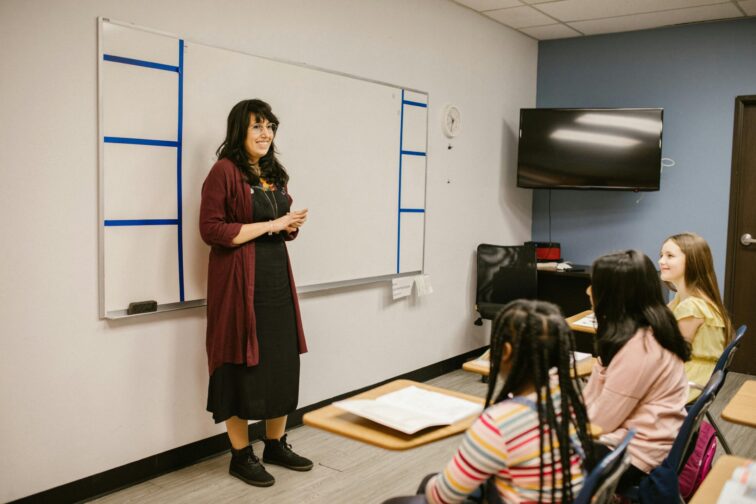
What changes when an educator does this inner work first? In Dr. Gray’s lower elementary special day class, the day begins with a student-led affirmation: we are brave, we are smart, we are beautiful. Then twenty minutes of free play with Legos and magnet tiles, where five and six and seven year olds practice the skills they are formally classified as struggling with: social engagement, collaboration, perspective-taking. Then calendar, where one student’s daily role is to tell the class how they feel.
First graders. Second graders. Third graders. Naming sadness, anger, frustration out loud, to a room of peers who often respond by rubbing a back or saying it’s okay.
The academic side does not soften under all of this. It sharpens. Dr. Gray’s students sit and work for thirty, forty, sometimes forty-five minutes, well past the fifteen-minute benchmark often cited as the ceiling for this population. They do so because they have been given something rarer than an accommodation: agency over their own bodies. “How else will they trust themselves if we don’t teach them to trust themselves?” Dr. Gray asks. Students who need to rock in a chair, lay in the library corner, or get water, do. Students who do not, work.
Visitors regularly walk into the classroom and assume it is not a special day class at all.
Inclusion is a posture, not a placement
This is the quiet shift that the next era of inclusive education has to make. Inclusion is not a designation written on an IEP. It is a posture the teacher inhabits, moment to moment, that says: your nervous system is welcome here; your body’s signals are information, not defiance; the things that make you different are not the things we are trying to fix today.
That posture cannot be performed. Children, especially those whose lives have taught them to read adults carefully, can feel the difference between a teacher who has done their inner work and a teacher who is reciting the script.
This is also why our founder Dr. Ilana Nankin has long described our first commitment as transforming educators, not students. After her own first year of teaching, she came home and could not do anything but lie horizontal on the couch, a true story from our founder’s first year, not from laziness, but from holding too much for too long with no place to put it. That experience, multiplied across 20,000+ certified educators, 250,000 educators transformed, and 750 district partners, is the throughline. You cannot give from a body that is empty. You cannot regulate a child from a body in alarm.
There is even early evidence the inverse is true. In a recent district study of 50 educators who completed Breathe for Change training, students of those educators showed a 15% reduction in chronic absenteeism compared to peers in the same schools (Breathe for Change district research, 2024). Children who feel safe come back. Children who don’t, don’t.
Where to start, before the next bell
If you are reading this and recognizing yourself, in the version of you that has the right strategies and the wrong nervous system, the work is not to do more. It is to do something different.
Three places to start:
- Stop trying to fix yourself before tending to yourself. Many educators arrive at trauma-informed work the same way Dr. Gray arrived at yoga, looking for a tool to fix what they thought was broken in them. The shift that changes practice is not a better tool. It is the recognition that you are not broken, and the body you bring into the classroom each morning is the curriculum.
- Build mindful listening into your day, with adults too. Listening without interjecting, without offering advice, without rehearsing your reply, is among the most underused skills in education. Dr. Gray calls it the single biggest game changer of her thirty-year career. Students sense it instantly. So do colleagues.
- Give bodies agency, including yours. If the rule is that the children in your inclusive classroom can stand, rock, get water, take a break when their bodies say so, the same rule has to extend to the teacher. Educator sustainability is not a separate category from instruction. It is the prerequisite for instruction that lands.
The future of education is human
Education is being asked to do more, with more complexity, in front of students whose lives outside school have grown harder. The temptation will be to reach for more programs, more frameworks, more checklists. The frameworks have value. The checklists are useful. Neither is the thing.
The thing is the human at the front of the room, whose nervous system is the first lesson plan of the day. In an inclusive classroom, especially, that lesson plan is the one students remember.
This is the work.
The William Jewell College Master’s of Science in Education (M.S.Ed.) in Transformative Teaching & Learning, in partnership with Breathe for Change, was built around it. Across 30 credits, educators learn the five dimensions of the Human Intelligence framework, somatic, emotional, cognitive, relational, and universal, by first practicing them in their own bodies, in community with other educators doing the same. The result is not a teacher with a new technique. It is a teacher who has changed the conditions students walk into. For educators ready to do that work, the M.S.Ed. is enrolling now. Learn more here.
Want to go deeper? Listen to the full conversation between Dr. Ilana Nankin and Dr. Salina Gray on A Work of Heart, the Breathe for Change podcast. They cover trauma-informed teaching in inclusive classrooms, the educator’s nervous system as the real curriculum, and what changed across three decades of teaching once Dr. Gray began doing the inner work first.