Dr. Kris Evans was a sophomore, undersized for the field, and his hamstring was wrecked. The football coach at Stanford told him to go do yoga. Kris went, mostly to keep up with the team. He stretched, he sweated, he felt better afterward, and he didn’t think much else about it. “It was fun because of the social component,” he says now. “I felt viscerally better, don’t doubt about it. But it wasn’t like I was tuned in.”
It would be another decade before Dr. Evans understood what that class had actually been offering him. And by then, he wouldn’t be a football player anymore. He’d be a researcher at Stanford’s Mind and Body Lab, asking the question that quietly drives his whole career: what is the skill that turns a body and a mind into one functioning person, and why isn’t anyone teaching it?
Who he is
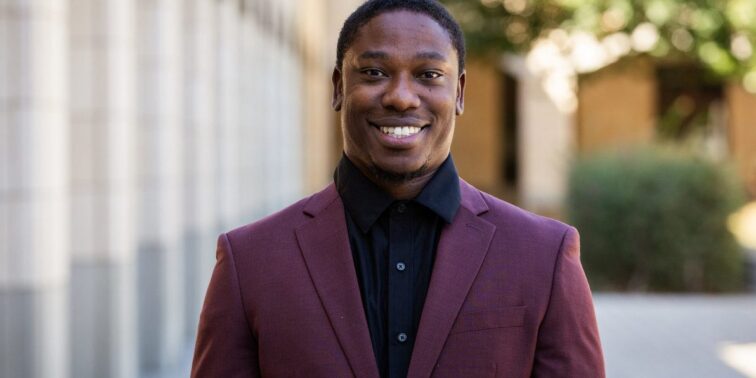
Dr. Kris Evans is a research scientist at Stanford University’s Mind and Body Lab, working under Dr. Alia Crum. He earned his B.A. in Sociology and Communications from Stanford and held an NSF Graduate Research Fellowship through his doctoral work. He is also faculty at Breathe for Change, teaching psychology in the William Jewell College Master’s of Science in Education (M.S.Ed.) in Transformative Teaching & Learning, in partnership with Breathe for Change, and a longtime research collaborator with founder Dr. Ilana Nankin.
His work, distilled, is about how mindsets, stress, and beliefs shape human health, well-being, and physiological performance. He studies, with rigor, the thing most of us treat as airy: that what you believe about a stressor shapes what that stressor does to your body. That a one-hour mindset intervention can change how a person processes a major life challenge for months afterward. That awareness, the kind you can train, is one of the most powerful agents of change available to a human being.
His work
Most performance research treats the body as the variable. Dr. Evans’s work, alongside the Mind and Body Lab, treats the mind as the variable that shapes what the body even does. A stressor reframed as a challenge, not a threat, produces a different inflammatory response. An expectation of recovery, deliberately cultivated, changes how recovery actually unfolds. A person who learns to watch their own state during a hard moment recovers faster than a person who simply endures it.
The line he keeps coming back to is meta-awareness. Not “be present” in the vague, motivational sense. The specific, trainable skill of watching your own mind while it’s in motion. “It’s actually about our awareness that we even have a mindset in the first place,” he says. “You get to choose in that moment of awareness.” That choice is what he means by agency. It is the through-line of his research, and the reason a performance researcher ended up at a podcast table talking about teachers.
His story
He grew up in Michigan, played football into college, and was, by his own account, devoid of contact with any of this. “I think like most Americans, you grew up in the Midwest, you often are not exposed as a function of culture in our society to many of these practices,” he says. Yoga was a hamstring rehab. Meditation was for other people. Then, with that chapter behind him, he started exploring it on his own and the floor dropped out. “It was transformational. I mean, there’s a lot of different ways in which we could talk about that. But I think the biggest insight for me was first off, to practice yoga is about being more mindful: how you think, how you act, how you feel.”
He went to a 200-hour yoga teacher training in 2015, the same year Dr. Ilana Nankin founded Breathe for Change. The two had been introduced by a mutual friend who said, “you have to meet this guy.” They met in San Francisco and talked for six hours. “It was clear we had a shared worldview and set of values,” he says. The friendship became a working partnership. Together they have led trainings for thousands of educators. Together they have conducted research that gave the work an evidence base.
Intersection with Breathe for Change
Dr. Evans is faculty in the M.S.Ed. in Transformative Teaching & Learning at William Jewell College, in partnership with Breathe for Change, where he teaches psychology. He is also Dr. Nankin’s longtime research collaborator. The two of them designed and ran a study of 350 educators across five cohorts, measuring mindfulness, stress, well-being, and belonging. The results, including effect sizes above 1.2 on the Five Facet Mindfulness Questionnaire and significant improvements in well-being and belonging, are part of the empirical case that Breathe for Change’s approach actually works.
It is unusual for a Stanford performance researcher to make educators his population of choice. The reason he gave on the podcast was simple. “Being present is essential for learning. Simple as that. A lot of young people, anyone at any given age, when your attention is disregulated, you cannot learn. But especially when you learn how to regulate your attention with awareness, it amplifies.” The lever, he believes, is the educator. Train an educator in meta-awareness, and you change a classroom. Change enough classrooms, and you change a generation.
Takeaway for educators
If you take one thing from his work, take this. The skill that decides how your year goes is not your content knowledge, your classroom management system, or your tolerance for hard days. It is your capacity to watch your own mind while it’s in motion, and choose how you respond from there. That skill is trainable. The research is unambiguous. And the practice can start with a single breath tomorrow morning, before you touch your phone.
Dr. Evans’s framing maps directly to what Breathe for Change calls Human Intelligence: the cognitive and somatic capacities that let educators show up present, regulated, and genuinely responsive to students. Meta-awareness isn’t a wellness add-on. It’s the mechanism. And it’s exactly what AI cannot replicate in a classroom.
Where to learn more
Dr. Evans’s research is housed at the Stanford Mind and Body Lab and his profile is available through Stanford Technology Ventures Program. For educators who want to learn directly from him and from the rest of the Breathe for Change faculty, he teaches psychology in the M.S.Ed. For a closer look at the research that grounds his work, see what neuroscience reveals about Human Intelligence in education.
The M.S.Ed. is enrolling now. Explore the M.S.Ed.
Listen to the full conversation between Dr. Ilana Nankin and Dr. Kris Evans on A Work of Heart, the Breathe for Change podcast.