
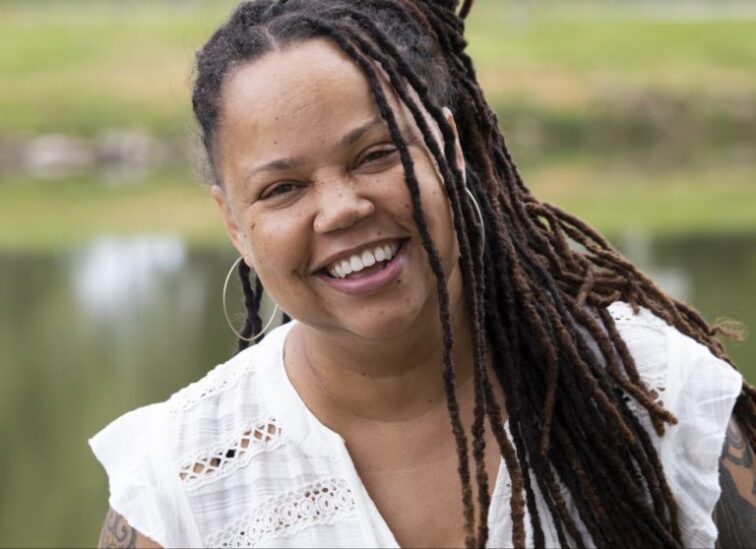
She walks into a high school event expecting to see former students light up. They had been her middle schoolers, the kids she had toughened up for the world, the kids she thought she had served. Three of them spot her and make a beeline in the other direction. Later she learns from another student that they had told their friends they hated her.
Dr. Salina Gray, who has now been teaching for over thirty years, lets that memory sit in her body for a beat before talking about it. “It hurts my heart and I’m so ashamed right now thinking about it,” she says. Then she keeps going, because the work she does now is built on having let that memory in.
Who is Dr. Gray
Dr. Gray is a Stanford-trained educator and a longtime classroom teacher across middle school, high school, elementary, and now Special Day Class for grades one through three. She holds a PhD in Education. She is also a faculty member in the William Jewell College Master’s of Science in Education (M.S.Ed.) in Transformative Teaching & Learning, in partnership with Breathe for Change.
The arc of her career is unusually wide. The arc of her teaching practice is even more unusual: a deliberate, decades-long reconstruction of how she shows up in a classroom, after recognizing that good intentions had not been enough.
Her work
Dr. Gray’s current classroom does not look like most special education rooms.
The day starts with rituals. A student leads the class in an affirmation. Another leads calendar. Another runs skip counting. Twenty minutes of morning tub time built around magnetiles, Legos, and Rubik’s cubes lets students collaborate before any academic block begins. The wall behind her holds a feelings chart that students return to, by name, multiple times a day.
The kids sit. Twenty, twenty-five, thirty minutes on a single task. Sometimes longer. “My kids can sit twenty, twenty-five, thirty minutes and work on one task,” Dr. Gray says. “In a world where people often say the goal is if you can get them to sit for fifteen.”
What is happening underneath those numbers is the practice she has spent a decade developing: agency built into the schedule. Students can take a movement break, sit in the rocking chair, get water, or rest in the library if their bodies tell them to. The expectation is not control. It is attunement. “How else will they trust themselves if we don’t teach them to trust themselves?” she asks.
Visitors do not believe it is an SDC classroom. The students are first, second, and third graders, many on the autism spectrum, many with significant trauma histories. They are also, when you watch them, regulating, communicating, and learning at a level that defies the usual framing of what these students “can” do.
Her story
Dr. Gray’s classroom did not always look like this.
For roughly her first two decades of teaching, she ran a tighter, more militaristic room. The intent was protective. “I wanted to create a healing space,” she has said, “but I wasn’t healed enough to do the work that I was trying to do.” Her own unaddressed trauma, the version of herself that grew up in chronic dysregulation without language for it, was running the classroom alongside her.
She did not have the framework yet to see this. She had the instinct to bring movement and breath to her students, and tried to teach them yoga without training. She knew something was missing. In late 2016 she found Breathe for Change online, called the number on the spot, and signed up.
The training did not deliver what she expected. She came in to learn how to teach yoga to her students. What she found was that the curriculum opened with the educator’s own transformation first. “It was literally like the veil had been lifted,” she says. “I felt reborn. It was like waking up from a coma.”
What followed was a reckoning of self. Letters and conversations with former students, former colleagues, attempts at repair where repair was possible. The grace of accepting that some of those amends would never be returned. And a fundamentally different way of teaching, built on mindful listening, somatic awareness, and the slow rebuilding of self-trust.
Dr. Gray’s intersection with Breathe for Change
Dr. Gray began her relationship with Breathe for Change as a teacher training participant in early 2017. Over the years she has served as a mentor and as faculty in our programs, including the M.S.Ed. She is one of the educators who carries the work forward into other classrooms, schools, and graduate students.
Her teaching now embodies all five layers of the Human Intelligence framework: somatic, emotional, cognitive, relational, and universal. She did not set out to teach to a framework. She built the practice, and the framework named what was already there.
Takeaway for educators
If there is one thing in Dr. Gray’s story that is for everyone, it is the permission she gives to start over.
She had taught for two decades before any of this. She had a PhD. She thought she was the kind teacher in the building. The actual work, the work that has now built a classroom her students do not want to leave, did not start until she sat with the students who hated her and let it be true.
Her closing words for educators in a conversation with Dr. Ilana Nankin on A Work of Heart were these: “Wherever you are on your journey is the beginning of your journey. Every day is the start of a new journey. Be as gentle with yourself as you are with the babies.”
Where to learn more
Dr. Gray teaches in the Master’s program, which embeds the kind of inside-out work she describes into every course, from trauma-informed teaching to mental health in schools. Learn more about the Master’s in Education here.