
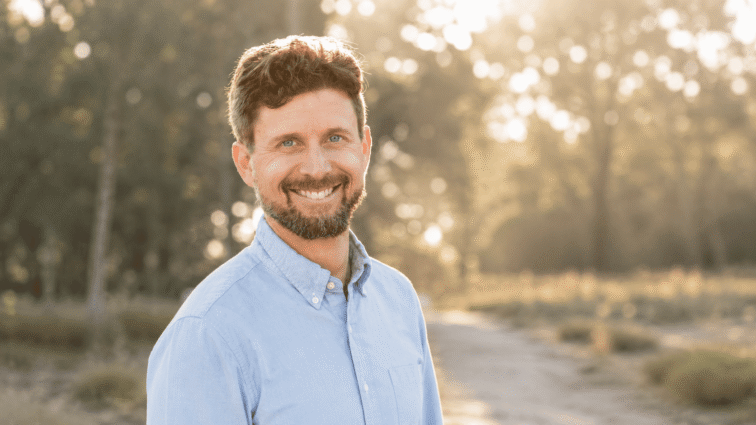
Dr. Michael Jacob has seen a human brain more times than he can count. Ask him what it looks like and he will not reach for the usual metaphor. It is not a machine. It is wet, he says, mushy and goopy, nothing like the sleek circuitry of a laptop. For a neuroscientist and psychiatrist who has spent his career studying that organ, this is not a throwaway line. It sits at the center of everything he believes about how humans learn.
Jacob is a neuroscientist and psychiatrist at the University of California, San Francisco (UCSF), where he treats patients, teaches medical students and residents, and runs a research practice that refuses to stay in one lane. He is also faculty in the William Jewell College Master’s of Science in Education (M.S.Ed.) in Transformative Teaching & Learning, in partnership with Breathe for Change, where he helps educators understand what is actually happening in the body and brain when they teach and learn. His through-line is a conviction that intelligence is far larger than the thinking, test-taking sliver that schools tend to measure.
A Scientist Who Studies the Brain Like an Artist
Most neuroscience treats the brain as an information processor, a computer made of meat. Jacob pushes against that. The brain is a biological system, he points out, one that evolved and develops in a particular way, soaked in blood and glucose and shaped by the body it lives in. “Everything that the brain is doing is it interpreting our world in the context of our values,” he says, the values that keep us alive, the values of the people around us, and the larger question of “what is the meaning of it all.” A computer, he argues, has access to none of that.
That conviction shows up in how he does science. Rather than studying artists and musicians as subjects, Jacob brings them in as collaborators, using their ways of thinking to inform how he interprets brain activity itself. He works with musicians and literature scholars because, as he describes it, the brain is an organ of prediction and expectation, and so are art and story: we shape an expectation, test whether it came out “quite right,” and feel for whether it touched meaning. He has come to think of the brain less as an algorithm and more as a creative organ, one whose outer layer is constantly rewiring itself. That is neuroplasticity, and in his telling it is not a special mode the brain switches into. It is simply what the brain does, all the time.
He is equally precise about stress. Drawing on the work of UCSF researcher Wendy Mendes and the biopsychosocial model of challenge and threat (Blascovich and Mendes), he explains that two students can face an identical exam with completely different physiologies. Threat constricts: the body braces as if a predator might bite, blood vessels tightening. Challenge mobilizes: the heart rate still climbs, but the system opens toward the hill it wants to charge up. Same stressor, different outcome, and the difference shapes what learning is even possible.
From a Father’s Math Books to a Daily Meditation Mat
Jacob’s path began, improbably, with pictures. His father was a mathematician with a tall stack of textbooks, and the only one young Michael ever opened was a book on chaos and fractals, because it had beautiful images. The swirling, strange-attractor diagrams stopped him cold. Was that math, or was that art? He never fully resolved the question. He built a career inside it.
Early on, he admits, he took the reductive view: the brain is the most complicated thing that exists, so just focus on the brain. “Then I had to kind of realize, oh wait, there’s a lot more than that,” he says. Teachers and mentors helped him see differently.
One practice has anchored him for decades. Jacob meditates twice a day, close to two hours in total, a discipline almost unheard of among working psychiatrists. He resists framing it as relaxation. Sitting, he says, can feel more like sitting in a volcano. He started out simply wanting to focus better and stayed because the practice expanded his “capacity to just be there in my life the way that I want to be.”
From his mentors he inherited a phrase he now teaches his own students: negative capability, the poet John Keats’s term for the ability to rest in “mysteries, uncertainties, and doubt without irritably reaching after fact or reason.” The biggest wisdom he carries, he says, is the willingness to say “I don’t know.”
Where His Science Meets the Classroom
Jacob’s collaboration with Breathe for Change began close to home. The organization’s founder, Dr. Ilana Nankin, is his cousin, and what started as family conversations grew into shared work expanding the definition of intelligence. Together they have been building out the Human Intelligence framework, Breathe for Change’s model of the cognitive, emotional, relational, somatic, and universal capacities that drive teaching and learning. As faculty in the M.S.Ed., Jacob helps educators connect that framework to the underlying science, including the brain-heart coherence work that, in one early demonstration with a HeartMath sensor and a loving-kindness meditation, moved both of them to tears.
What Educators Can Take From This
Jacob’s science circles back to something educators already sense: connection is not soft. Decades of resilience research point to a finding he repeats with conviction, that for children carrying trauma and stress, one caring adult who believes in them can change the trajectory of a life (Harvard Center on the Developing Child). “That’s not going to come from a multiple-choice test,” he says. The invitation for educators is small and concrete: notice whether a given student is experiencing your classroom as a threat or a challenge, and ask what one steady relationship might make possible.
Going Deeper
Jacob continues his research and teaching at UCSF. Educators who want to explore the science of Human Intelligence in depth can learn more about the M.S.Ed., where he serves as faculty.