
Every experienced teacher knows the feeling that arrives a few seconds before the noise does. The temperature of the room changes. A student’s shoulders climb toward their ears, a pencil hits the floor, and somewhere near the back a leg starts moving under a desk at a speed that has nothing to do with restlessness.
What we say in the next fifteen seconds decides the rest of the period.
It’s one of the most consequential moments in the working life of an educator, and almost nothing in conventional training prepares us for it.
What American schools built over the past century is a reflex, and the reflex is to reach for a consequence: a verbal warning, a logged incident, a referral, a phone call home. This is the discipline system, and it’s been the default architecture of the classroom for so long that it can be hard to recognize as a choice at all.
It’s worth saying plainly that the discipline system solved a real problem. Before it, a student’s fate depended on which adult happened to be in the room and what kind of morning that adult had. Codified consequences made responses predictable, legible to families, and defensible when challenged. That isn’t nothing, and any argument that ignores it won’t survive contact with the people who actually run schools.
But by the profession’s own account, it isn’t delivering. In a nationally representative survey of more than 1,000 teachers and administrators conducted in spring 2026, 75 percent of educators said they expect student behavior to be a challenge this year, and 37 percent reported that behavior had gotten “a lot worse” over the previous school year (EdWeek Research Center, 2026).
Schools have answered that pattern before, and each answer was a response to the limits of the last one. Rules told students what to do. Consequences gave the rules teeth. Restorative practices addressed what consequences left unrepaired, which was the relationship. Each rung was real progress. Each one also rested on the same assumption: that the student in front of you is in a position to choose.
Regulation is the next rung, and it’s the first one to question the assumption. Nervous system regulation isn’t a gentler substitute for classroom management. It’s the layer of it that has been missing all along. You can’t consequence your way out of a dysregulated nervous system, because the dysregulated nervous system isn’t the thing making the decision the consequence is meant to correct.
The Body Before the Behavior
Polyvagal Theory, first published by Stephen Porges in 1995, proposes that the autonomic nervous system moves between three hierarchical states: social engagement, mobilization in fight or flight, and immobilization in freeze or shutdown. The movement between them is a physiological event, and it precedes voluntary behavior. By the time a student has thrown a pencil, their body has already left the state where reason, empathy, and impulse control are available to them (Porges, Psychophysiology, 1995). (Polyvagal Theory is widely applied in trauma-informed and educational contexts; some of its neuroanatomical specifics remain debated among neuroscientists.)
Sam Levine, Breathe for Change faculty in psychology and leadership, describes the reactive moment in terms most of us will recognize immediately: “There’s this reactive moment where it’s like, all right, I’m feeling really charged or my students are feeling really charged or there’s something that’s about to escalate, and the power in just let’s take three deep breaths and see where we’re at after we’ve allowed our nervous system to recalibrate just a little bit.”
Those three breaths aren’t enforcing compliance. They’re a shared physiological intervention, offered in the seconds when physiology is the only thing that can be reached.
That distinction carries the entire argument. A discipline system assumes behavior is a choice the student is making, and that a firm enough consequence will change the choice. A regulation-based approach starts instead from what we watch happen every day: behavior is frequently what the body is already doing before the student has any real opportunity to choose. When the body is mobilized, the behavior is mobilized with it. The shortest route to different behavior runs through a different bodily state.
The Sequence Schools Get Backwards
The order matters more than the techniques, and it’s where most well-intentioned efforts go wrong. Educators moving toward a regulation-based approach tend to begin with breathing exercises. Reasonable instinct, incomplete one, because regulation can’t happen without awareness and most students don’t arrive with much awareness of their own bodies. Dr. Ilana Nankin, co-founder and co-CEO of Breathe for Change, ran into this in her own classroom: the majority of her students had very little sense of what was happening inside them.
The neurological literature supports what she observed. Interoceptive awareness, meaning the perception of internal bodily signals, is consistently linked to emotion regulation, and disrupted interoceptive awareness is associated with difficulty regulating emotion across a range of populations (Price & Hooven, Frontiers in Psychology, 2018). That research base draws heavily on clinical populations, and direct classroom trials remain an emerging area. The foundation is firm enough to build on. Students can’t regulate what they can’t feel.
Nankin states the implication plainly: “[Students] cannot regulate themselves if they aren’t aware of what is happening in their body. And that’s the first step.”
Which is why the body scan belongs in the first week of school rather than in the middle of a crisis. Students learn to notice what’s happening in their bodies during the stretches of time when nothing much is happening at all, so that the capacity is already built and available on the afternoon when the room turns. Awareness practiced in calm becomes regulation accessible in difficulty.
Co-Regulation as Classroom Infrastructure
There’s a piece of this that separates it from an individual mindfulness pitch, and it concerns what happens when a room breathes together. When a teacher and a class take three breaths in a charged moment, the mechanism at work is co-regulation, the reason collective breathing does more than individual breathing. A regulated nervous system, physically present in a room, gives every other nervous system in that room a signal to synchronize toward.
Students read the state of our bodies well before they process the content of our words.
That reframes teacher self-regulation as considerably more than a wellness benefit. It’s a functional classroom management capacity, because a teacher whose own system is mobilized has no regulated state to offer, and co-regulation can’t flow from a body that’s itself in fight or flight. It’s also why the somatic layer of the Human Intelligence framework begins with the educator rather than the student. We practice the body scan on ourselves before leading it with a class, and take three breaths for our own nervous systems before inviting thirty others to follow.
The training data suggests the sequence holds. Educators trained in this approach report using breathing strategies with students at 91 percent, compared with 22 percent among comparison groups, and mindful movement strategies at 64 percent compared with 15 percent. [Citation needed: source for Breathe for Change partner-school outcome data.] Teachers who regulate themselves keep doing it with students.
From One Classroom to a Building
The mechanism doesn’t change across a school. What changes is who supplies the regulated state, and how much of it a student can supply on their own.
Elementary | Regulation is almost entirely adult-supplied. A five-year-old’s capacity to self-soothe is still under construction, so the teacher’s nervous system is the instrument. The practical implication is unglamorous: proximity is an intervention. Which adult stands where, and how often, does more for a kindergarten classroom than any chart on the wall.
Middle school | The peer nervous system arrives, and the room begins co-regulating the room. Dysregulation spreads faster at this age than at any other, and so does settling. This is where three collective breaths earn the word collective. The practice works because thirty bodies are signaling to each other, not because thirty bodies are each performing an exercise.
High school | Self-regulation becomes teachable. Students can name states, notice their own escalation, and choose an intervention, which shifts the work from doing it for them to giving them the vocabulary and the repetitions. A student who can say “I’m in fight or flight right now” is doing something a warning could never have produced.
Schoolwide | Regulation stops being teacher heroics and becomes structure: a somatic practice in the opening minutes of every period, a regulation step written into escalation protocols, a staff culture where the adults regulate first. Breathe for Change’s partner schools have recorded an 8 percent reduction in student absenteeism, a 92 percent attendance rate running significantly above comparison groups, and a 15 percent lower rate of chronic absenteeism year over year. [Citation needed: source for Breathe for Change partner-school outcome data.] This is the scale at which school leaders find that community-building practices move the metrics their accountability reports already track.
The neuroscience isn’t background color for figures like these. It’s the mechanism that produces them.
What Changes on Monday
Treating behavior as a regulation problem rather than a compliance problem reorganizes a surprising number of ordinary decisions.
- Regulate before you respond. The reactive moment gets three collective breaths first, with consequences following once the room has settled rather than preceding it.
- Seat for proximity. Charts account for which students need to be near a regulated adult, and where.
- Open with the body. The first minutes of class carry a somatic practice, included not as a pleasant ritual but because it moves the room into the state where learning is neurologically possible.
- Read behavior data for state. What a student’s body was doing belongs in the record alongside what the student did.
- Write regulation into the escalation protocol. A regulation step positioned before the discipline step, not in place of it.
- Fund the adult layer first. For school leaders: staff regulation isn’t a wellness perk competing with instructional priorities. It’s the supply side of every classroom’s capacity, and it should be budgeted that way.
- Measure what you’re actually asking for. If regulation is the expectation, then attendance, referral rates, and time-to-recovery are the scoreboard, not compliance counts.
None of this removes the need for structure, agreements, or accountability. Community agreements still matter. Consequences for harming others still exist.
Regulate first. Then address the behavior with a student whose body can actually hear you.
A practical starting set of nervous system tools for behavior management tends to be shorter than most schools expect, precisely because each tool meets the body before it addresses the behavior.
Back to the Pencil
Return to the pencil on the floor, the leg moving under the desk, the change in the room’s temperature we register before anyone has done anything at all. In a discipline-first classroom the next move is a warning, and the period that follows is usually spent in recovery. In a regulation-first classroom the next move is three breaths, taken by the teacher and then by the class, after which there’s a conversation about the pencil with a student who can actually participate in it.
A class that can be brought back from that edge in fifteen seconds is a fundamentally different class from one that spends forty minutes being reassembled, and the difference has almost nothing to do with the rules posted on the wall.
Here is Nankin on the students she taught before any of this had a name: “The majority of my students unfortunately had very little body awareness. It would often get hijacked by something. It would almost be numb to what was happening in their bodies.”
That’s who is in the room. Not students refusing to choose well. Students who can’t yet feel what they would be choosing from. The first thing we can teach them is how to notice.
Somatic Intelligence is one of five layers of the Human Intelligence framework at Breathe for Change, and it’s taught in full depth in the William Jewell College Master’s of Science in Education (M.S.Ed.) in Transformative Teaching & Learning, offered in partnership with Breathe for Change. Educators leave the program with the neuroscience, the practices, and the pedagogical sequence to teach regulation as fluently as they teach content. If that’s the kind of teacher you’re becoming, the M.S.Ed. is enrolling now.
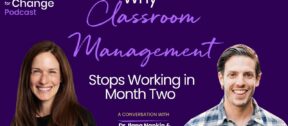
Want to go deeper? Dr. Ilana Nankin and Sam Levine walk through the somatic practices in full in A Work of Heart, the Breathe for Change podcast, including the body scan, three collective breaths, and sun breath demonstrated live.