
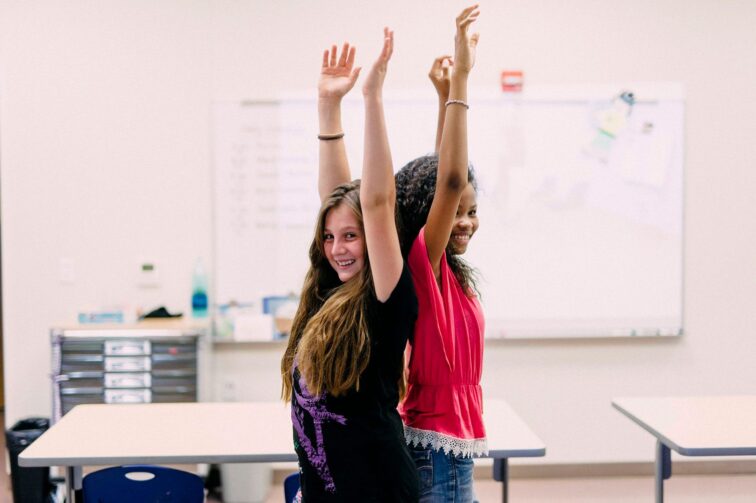
Before your students can focus, settle, or learn a thing, their nervous systems are already doing something automatic: reading yours. Psychologists call it co-regulation: the way a steadier adult helps a child reach a calm they can’t get to on their own yet. It isn’t a soft idea or a nice-to-have. It’s how self-regulation develops in the first place, through warm, responsive, predictable adults (Rosanbalm & Murray, OPRE practice brief, 2017).
And it runs both directions. In a study of more than 400 elementary students, kids in classrooms with more burned-out teachers showed higher morning levels of cortisol, the body’s main stress hormone, and teacher burnout explained over half the difference between one classroom and the next (Oberle & Schonert-Reichl, Social Science & Medicine, 2016). Your state is, quite literally, in the room with them.
Here’s the good news hiding in that research: if your stress is contagious, so is your steadiness. And the ten minutes you spend in a morning circle, before any content, is where you decide which one spreads.
Picture 8:12 AM. Three of your second graders are already at the door: one crying, one clutching a worksheet he forgot last night, one radiant, holding a leaf. The bell hasn’t rung. Math is forty minutes out. What you do in the next ten minutes will shape the next eight hours more than your lesson plan will.
If you’ve hit the wall this year, the wall is real: teaching now ranks as the most burned-out profession in the country (Gallup, 2022), and educators are about twice as likely as other working adults to report frequent job-related stress (RAND, State of the American Teacher, 2022). The five practices below are the part of the day that lets you, and them, walk past it.
1. Start every morning with a community circle
Sit on the rug, in a circle, with your students, not running the morning from behind your desk or the document camera. The content barely matters here. What matters is that everyone in the room sees everyone in the room before anything else begins.
Five minutes. That’s the whole budget.
- Younger students: sit cross-legged on the floor with them. Eye level matters.
- Older students: a standing circle works. So does a horseshoe of chairs. The shape is the practice.
- The days it feels like there’s no time for the circle are the days you can’t skip it. The harder the morning looks, the more the circle earns its place.
2. Take three collective breaths
Once you’re in the circle, breathe with them. Three slow inhales, three slow exhales. Audible, together.
If you’ve never done this with a class, it can feel a little silly for the first few seconds, and then the room often settles. That settling is co-regulation happening in real time. Your nervous system is the loudest one in the room, and theirs track it whether anyone means for them to or not. Three breaths together is about the cheapest, fastest reset you’ve got. (The science of SEL facilitation goes deeper here.)
3. Run the two-word check-in
Then go around the circle: two words each. Not a full sentence, just two.
- Students with the vocabulary for it: “Tired, hopeful.” “Curious, hungry.” “Brave, nervous.” Their words, not yours.
- Younger students, or anyone still building emotional literacy: try a weather report instead. “Sunny.” “Foggy.” “Thunderstorm.” “Drizzly.” The image does the naming for them. (Here’s the two-word check-in, step by step.)
You’re not solving anything yet. You’re getting a read on who’ll need a little extra holding today and who’s steady enough to help hold someone else. That read is the rest of your morning plan.
4. Teach the Peace Process before the conflict arrives
Conflict will show up today. A pencil will go missing, someone will get cut in line, someone will say something unkind. The only question is whether you handle it or the class does.
Teach the four-step Peace Process, and they handle it:
- Observation. State only what happened, in one sentence, with no interpretation. “When you took my pencil.”
- Feeling. Name how you felt, in a word or three. “I felt frustrated.”
- Need. Name what you needed. “Because I needed to finish my work.”
- Request. Make a request. “Would you be willing to ask me next time?”
Model it the first ten times and they’ll carry it the next ten thousand. (Full Peace Process walkthrough with classroom scripts here.) Beth Schreiber, a second-grade teacher in Stevensville, Montana, built a “peace corner” in the back of her room and taught these four steps until her students were resolving conflicts there without her. The tattling stopped. The repair started.
5. Close the day the way you opened it
Whatever the morning circle starts, the closing circle finishes. One round, one word each: one thing they’re taking home, one thing they’re leaving behind. Thirty seconds.
A strong close protects your evening, too. Your students stop carrying the day home with them, and so do you.
Try one tomorrow
If you try a single thing, make it the three breaths. Before your first lesson, ask your students to take three slow breaths with you and watch what happens to the room.
You don’t need to install the whole sequence at once. Add one piece, watch what shifts, and reach for the next when the first one feels steady.
For the framework behind why these practices work (physiologically and relationally), start with what neuroscience reveals about Human Intelligence in the classroom.
These practices are at the heart of TeacherCon, Breathe for Change’s free monthly three-day professional development event for educators. Come explore them alongside thousands of other educators building this kind of classroom. Register free here.
If you want to build practices like these into the foundation of how you teach, explore the M.S.Ed. in Transformative Teaching & Learning from William Jewell College, in partnership with Breathe for Change.
Want to hear how one teacher rebuilt her whole classroom around practices like these? Listen to the full conversation with Beth Schreiber and Superintendent Jon Konen on A Work of Heart, the Breathe for Change podcast.