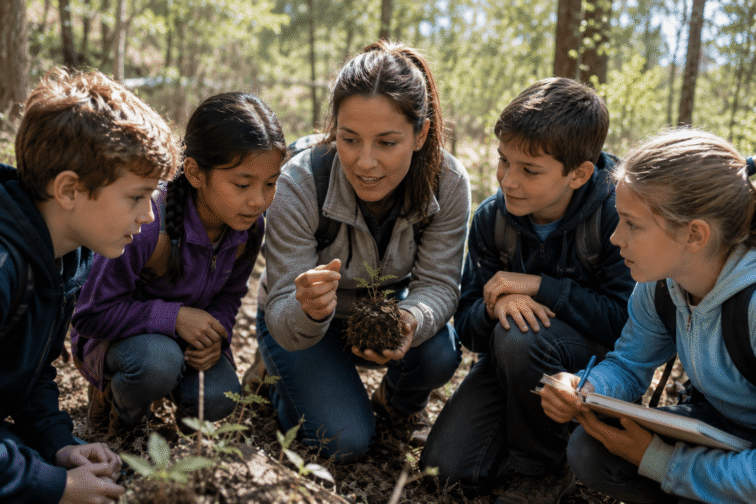
Ask a three-year-old why the sky is blue and you’ll get three more questions before you finish answering. Why is the ocean blue too? Is the sky made of water? Where does it stop? They’re not fishing for the right answer. They’re following the wonder wherever it leads, and they’d stay out there all afternoon if you let them.
We’re born doing this. Long before our species had answers, we had questions, and the restless, particular pleasure of sitting inside one. Curiosity, awe, the urge to poke at a thing until it gives something up: these were never school subjects. They’re the oldest equipment we carry. And somewhere between kindergarten and graduation, most of us quietly learn to set them down.
That capacity isn’t just charming. It’s how children learn. Developmental researchers describe awe as emerging in toddlerhood and driving the very “cognitive accommodation,” the mental rewiring, that early learning depends on; curiosity is what primes a child’s brain to take in something new (Frontiers in Psychology, 2022). The questions a kid can’t stop asking aren’t a detour from learning. They’re the engine of it.
Something changed this year that should make us pick that engine back up.
The answer stopped being the rare thing
A student can now get the answer to almost any question in the time it takes to type it. For as long as there have been classrooms, the answer was the prize: the thing we organized lessons, tests, and worksheets around delivering. That prize is now free, instant, and sitting in every backpack.
So the value moves. It moves to the part that always came first and rarely got taught: knowing which question is worth asking, and being willing to stay in it before reaching for a reply.
Most teachers weren’t trained for this. They were trained to deliver content, assess content, and run a room full of kids who needed it delivered. Then the ground shifted under them. And it shifted while the job was already getting heavier: roughly 75% of educators report moderate or significant stress every single day, and educators are about twice as likely as other working adults to report frequent job-related stress (RAND, State of the American Teacher, 2022). Teaching now sits among the most burned-out professions in the country (Gallup, 2022).
When everything gets heavier, the reflex is to push harder on what we already know how to measure: more content, more drills, more practice problems. More of exactly the skill the machine already does better. That road is a dead end, and we can see the end of it from here.
What a second-grade teacher noticed first
Beth Schreiber teaches second grade in Stevensville, Montana. Or she did, until her work pulled her into the district curriculum director’s office. She came to her superintendent’s attention for something most evaluation rubrics miss entirely: she was barely sending anyone to the office. Her room had a settledness other rooms didn’t. When Superintendent Jon Konen started walking through each morning, he caught what she was actually doing all day. She was asking.
“It’s always very clear, directed, prompted questioning,” Beth says. “We’re not giving answers and we’re not even giving directives. We’re prompting collective creative conversations, but moving them in an intentional direction.”
That’s the move a machine can’t make for her. An answer engine can’t read which question the room needs first. It can’t tell that the eight-year-old who went quiet isn’t bored. It can’t feel that a staff meeting is stuck on the wrong premise. It isn’t in the room, so it can’t know what the room hasn’t said yet. A teacher who can ask what’s really going on here, and how do we figure it out together is doing the work that doesn’t automate.
Dr. Ilana Nankin, who founded Breathe for Change, puts the stakes plainly: “We have to teach people how to effectively question. Answers are at our fingertips in any second. But if we don’t know how to ask questions and grapple deeply in the unknown space, that’s what remains uniquely human.”
This is what Breathe for Change has spent more than a decade building toward. The Human Intelligence framework names five layers educators draw on to teach this way: cognitive (how we think and reason), emotional (how we read and steady our feelings), somatic (how we read and steady our bodies), relational (how we connect), and universal (how we ground in purpose). Seen through that lens, asking a real question isn’t a clever cognitive trick. It’s all five layers working at once, out loud.
Why a real question takes a steady body
Here’s the catch that explains why questioning stays rare even though it sounds simple: to ask a real question, you have to tolerate not knowing the answer yet. That’s a nervous-system skill long before it’s a cognitive one.
A depleted teacher’s body lunges for closure. Get the answer, move on, cover the standard, survive until 3:00. There’s no room in that state for maybe we don’t know yet, but together we’ll figure it out. That sentence asks a lot of the person saying it. It asks for a body that isn’t running on empty at 2 p.m. on a Wednesday in February.
Which is why Beth’s turnaround didn’t begin with new lesson plans. It began with her own regulation. “We started working on self first,” she says. “And no one tells you in your job that that’s where you have to start.”
It’s tempting to file that under personal wellness and move on. That would miss the point: it’s a teaching strategy. A dysregulated teacher can’t host a real question, and a classroom that can’t host a real question can’t grow the skill that’s about to matter most. (More on the neuroscience of why regulation comes first.)
Here’s the loop worth noticing: a steady body makes wonder possible, and wonder, in turn, steadies the body. Among seven positive emotions researchers studied, awe was the strongest predictor of lower inflammation, specifically lower IL-6, a marker tied to chronic stress (Stellar et al., Emotion, 2015). People led to feel awe report greater life satisfaction and, strangely, more time; awe drops you into the present and loosens the clock’s grip (Rudd, Vohs & Aaker, Psychological Science, 2012). And it trains on a teacher’s budget: adults who took a weekly 15-minute “awe walk” for two months came away with more joy and less daily distress than those who simply walked (Sturm et al., Emotion, 2020).
Dr. Ilana tells a story from her own first year of teaching: coming home and lying flat on the couch, not from laziness but from holding too much, too long, with nowhere to set it down. The educators walking into the profession in 2026 are being asked to host harder questions than ever, in rooms with more AI than ever, often with less of themselves left over. The way through starts by restoring the educator.
What it looks like at full scale
Beth’s classroom built questioning into its bones, and now her district is doing the same. Jon leads decisions as teaming exercises instead of top-down calls. He walks into kindergarten rooms in the morning and asks teachers, what can I do to support you? The district has picked up protocols (the Utah Dignity Index, nonviolent communication, restorative circles) that all train one muscle: hold the space, ask the question, resist the urge to dictate the answer.
That tends to ripple outward. Awe has a way of shrinking what researchers call the “small self”: quieting self-focus and, in experiments, making people measurably more generous and more attuned to the group around them (Piff et al., Journal of Personality and Social Psychology, 2015). A room full of people who can wonder together is also, it turns out, a more generous room.
That’s Human Intelligence at the scale of an organization. Twenty-eight-year veterans and seven-year-olds, practicing the same thing in the same building. A line Dr. Ilana hears from educators all the time gets at the gap it closes: I have what I need to teach, but I’m walking in empty. The repair for that isn’t another lesson plan. It’s the part of the day that lets a teacher show up with enough of herself intact to wonder out loud with thirty kids.
More than 20,000 educators have now trained in these practices, with more than 20 million students reached. That number has sped up, not slowed, since AI arrived, and that tracks. The faster the tools get at answering, the more the human work of asking, staying, and connecting is worth.
Start with one day
TeacherCon, Breathe for Change’s free three-day online conference for educators, opens Day 1 on exactly this: how Human Intelligence, and the very human skill of questioning, holds up in the age of AI. It’s free, it grants live PD certificates, and it’s the simplest way to step into the work without signing up for a degree first. Reserve a seat here.
The teacher who matters most in the next decade isn’t the one with the most answers. She’s the one who can stand in the room when nobody has the answer yet, stay curious out loud, and ask the question that gets everyone moving. That’s the five-year-old’s gift, grown up and put to work, and it’s the one thing in the room that gets more valuable every year.
Want the whole story? Listen to Dr. Ilana Nankin, Beth Schreiber, and Superintendent Jon Konen on A Work of Heart, the Breathe for Change podcast: the practices Beth uses to build classroom culture, the systems Jon uses to build it district-wide, and the morning Beth’s seven-year-olds led a wish circle for her healing.